
Legal basis and overview
Anyone wishing to enter and reside in Germany from a non-EU country generally requires a valid German residence permit. This obligation is regulated in the Residence Act (AufenthG). EU/EEA citizens and Swiss nationals are exempt from these requirements - they enjoy freedom of movement rights and may live and work in Germany without a special residence permit. For all others (so-called third-country nationals), however, the law prescribes a residence permit.
The Residence Act distinguishes between various forms of residence title, which are essentially differentiated by the purpose and duration of the stay. The three best-known categories are the visa (for short-term stays or for entry), the residence permit (a temporary residence permit for a specific purpose) and the settlement permit (an unlimited residence permit for permanent residence in Germany). There are also special sub-categories - such as the EU Blue Card for highly qualified skilled workers or the EU permanent residence permit, which are discussed below. Each residence permit is only issued after a formal application and careful examination by the competent authority. Below we provide an overview of the most important types of German residence permits and their special features.
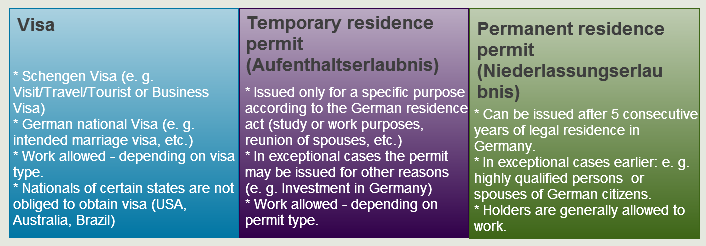
Visa: Short-term stay for entry
A Visa is the classic residence permit for Short-term stays in Germany. It is applied for at the German mission abroad (embassy or consulate) before entering the country. A typical example is the Schengen visa (category C), which is Stays of up to 90 days within a period of 180 days in the Schengen area. With a Schengen visa, you can therefore stay in Germany (and other Schengen states) for up to three months for visiting purposes - for example for tourism, family visits or business trips. Nationals of many countries in Africa, Asia, the Middle East and other regions of the world require such a visa in order to be allowed to enter Germany at all. For some privileged countries (e.g. USA, Canada, Australia and other so-called visa-free countries), on the other hand, their citizens do not require a visa for short stays of up to 90 days. No visa require. You may enter the country without a visa as a tourist or business traveller, but must leave the country within the stipulated period.
In addition to the Schengen visa for short stays, there is also the national visa (category D) for longer stays. This is issued if someone intends to stay in Germany for longer than 90 days - for example to study, work or as part of a family reunion. The national visa entitles the holder to enter the country and usually to subsequently apply for a residence permit in Germany. Applying for a visa always requires a personal appointment at the relevant German diplomatic mission abroad. Applicants must submit a valid passport, recent passport photos and the completed visa application. Depending on the visa type, additional proof must be submitted - for example, travel health insurance with sufficient cover (at least €30,000 for Schengen visas), proof of sufficient funds for the stay, proof of accommodation and documents relating to the purpose of the trip (such as a letter of invitation, admission to study or employment contract). Processing a visa application can take several weeks, so it is important to plan well in advance. The applicant can then enter Germany with a visa in their passport. For longer stays, it is necessary to register and apply for the actual residence permit at the foreigners authority after entering the country within the visa period.
Residence permit: Temporary residence title with purpose limitation
The Residence permit is the central temporary residence permit for longer-term stays in Germany. It is always for a specific purpose granted and is temporally limited in time. In practice, the residence permit is often initially issued for one to three years The exact duration depends on the purpose of residence and the individual circumstances (e.g. duration of the employment contract or study programme). An extension is possible as long as the purpose for which the permit was issued continues and the requirements are still met. The residence permit is usually issued after entryIn most cases, third-country nationals travel to Germany with a corresponding visa and then apply for a visa in Germany at the responsible Immigration office the application for a residence permit. Certain visa-free third-country nationals (e.g. from the USA or Australia) may also enter the country without a visa and apply for a residence permit within 90 days if, for example, they take up a job or start studying - but this must be done within 90 days. only, if the requirements for the desired residence permit are met.
It is important to know that a residence permit always earmarked is. This means that the Reason for the stay - for example, study, gainful employment or family reunification - is noted in the permit. A change of purpose of residence (e.g. from studying to gainful employment) normally requires a new application or at least an amendment to the existing permit, as different legal requirements apply in each case. A residence permit also entails Different rights and requirements along with it. Many residence permits also entitle the holder to Employment: Engaging in gainful employment, either as an employee or self-employed in Germany. (employee status or self-employment), either unrestricted or restricted depending on the purpose. For example, a person with a work permit may of course work in the intended job; a foreign student with a residence permit for study purposes, on the other hand, may usually only work for a limited period (e.g. 120 days per year). Likewise, a residence permit - depending on the title - can give access to social benefits (e.g. in the case of humanitarian residence permits) or exclude them. The exact Ancillary provisions (such as conditions or authorisations) are noted in the permit on a case-by-case basis. Anyone in possession of a temporary residence permit must also note that this can go out, if, for example, you leave Germany for a longer period of time or exceed certain deadlines. It is therefore advisable to inform the Foreigners' Registration Office in good time in the event of longer stays abroad or changes in your living situation.
Residence permit for work and study
The most common purposes for which a residence permit is issued include Employment: Engaging in gainful employment, either as an employee or self-employed in Germany. (labour) and Education resp. Study. Germany offers various qualified workers from abroad the opportunity to work here. Within the framework of skilled labour immigration law, for example, there is the Residence permit for skilled workers with a professional qualification or academic degree. A special form of residence permit for gainful employment is the EU Blue Card. The EU Blue Card is aimed at university graduates from third countries who are looking for a job in Germany that corresponds to their degree with a above-average salary have found. It is a Temporary title (usually initially for four years) and facilitates access to the German labour market for highly qualified skilled workers. Holders of an EU Blue Card can also apply for a residence permit under simplified conditions. Permanent settlement permit as a rule after 33 months of employment subject to social security contributions in Germany (or even after 21 months if sufficient German language skills at B1 level are proven). Other labour migrants, such as IT specialists without a university degree or tradespeople with vocational training, can also receive a temporary residence permit for gainful employment under certain conditions, provided there is a concrete job offer and proof of sufficient German language skills. recognised qualifications are available. In addition, Section 21 of the Residence Act (AufenthG) allows foreign Self-employed persons and investors a residence permit if they are pursuing significant economic interests in Germany by setting up a business or making an investment. In all cases of gainful employment, the foreigners authority often checks in cooperation with the Federal Employment Agency whether the labour market-related requirements are met (keyword Labour market admission).
Another important area is the Residence permit for study purposes. Foreign students who wish to study at a German university will receive a temporary residence permit in accordance with § 16 AufenthG. The prerequisite is usually a Authorisation to a university or university of applied sciences in Germany as well as proof of financing your studies (e.g. through a blocked account or scholarship). Students are allowed to work to a limited extent during their studies (currently usual: 120 full days or 240 half days per year). After successfully completing their studies, the Residence Act offers the possibility of extending the residence permit for up to 18 months to find a job to be extended. If the graduate finds a job during this time that corresponds to their degree, they can then switch to a residence permit for gainful employment (or EU Blue Card, if the requirements are met). Similar regulations apply to foreign Apprentices in vocational training programmes and for Scientists and Researchers, who come to Germany for research projects - they also receive special residence permits for specific purposes. To summarise, it can be said that Germany offers a variety of ways to obtain a temporary residence permit for professional or academic reasons.
Family reunification and humanitarian residence permits
In addition to work and study, the Family reunification another central purpose of residence. Family reunification refers to the immigration of Spouses, registered partners or underage children to a foreigner or German living in Germany. Both German nationals and foreigners who are authorised to reside in Germany can in principle bring their family to Germany, although different conditions apply depending on the constellation. Spousal reunification: A non-German spouse receives a residence permit for the purpose of Family reunification, if the marriage is legally valid and the intention is to live together in Germany. In many cases, the spouse moving to Germany must basic knowledge of German (level A1) before the visa is issued, so that language integration is supported from the outset. In addition, the authorities will check whether sufficient language skills have been acquired, especially when reuniting with foreign nationals. Living space and Livelihood are secured for the family (i.e. the partner living here must have sufficient income so that the state does not have to pay for maintenance). As a rule, these requirements do not apply to reunification with Germans, as German citizens enjoy a constitutionally protected right to marriage and family - nevertheless, a basic language certificate is often required from the spouse, and it is expected that no social hardship will arise. Children under the age of 16 generally receive a residence permit for the purpose of family reunification with their parents without any problems. For young people between the ages of 16 and 18, additional integration criteria are checked (such as language skills or living situation), as an independent right to family reunification is restricted in this case. If a foreigner in Germany has a valid residence permit or settlement permit, their nuclear family can generally move to Germany with them under the conditions mentioned.
Another category of residence permits results from humanitarian reasons. Persons who are recognised as Refugees or Persons entitled to asylum Recognised refugees, for example, receive a residence permit in accordance with § 25 AufenthG. Recognised refugees within the meaning of the Geneva Refugee Convention are generally initially granted a residence permit limited to one year. three years temporary title (with the possibility of extension), persons with subsidiary protection usually one at first one year temporary titles - in each case linked to comprehensive labour market access and social benefit entitlements. The law also recognises humanitarian residence permits for Special cases of hardship or for reasons of international law or urgent humanitarian reasons (Sections 22, 23, 25 Residence Act), for example for certain endangered situations or if it is objectively impossible to leave the country. In contrast to acquisition or family reunification permits, humanitarian residence permits are subject to the Concept of protection in the foreground. Such titles are often issued subject to conditions and can expire if the protective circumstances no longer apply (e.g. the danger in the country of origin no longer exists). Nevertheless, they offer those affected the opportunity to stay in Germany legally, either temporarily or for a longer period of time, and to gain access to integration measures. Important: A tolerated stay (temporary suspension of deportation) is No residence permit, but only a short-term right of residence on a discretionary basis. Those who hold a humanitarian residence permit, on the other hand, have a regulated status with a defined legal entitlement for the duration of its validity.
Settlement permit: Permanent right of residence
The Settlement permit is the most important indefinite residence permit in Germany. It entitles the holder to unlimited stay and for unrestricted gainful employment in Germany. Once issued, it must - unlike the temporary residence permit no longer extended be issued. However, the settlement permit is also subject to certain conditions. As a rule, it can be granted if the foreigner has been resident in Germany for at least five years has lived in Germany without interruption with a residence permit. Further core requirements are a secure livelihood (the applicant must have sufficient income to be able to live without social assistance), a Sufficient living space, the proof of at least 60 months of compulsory contributions into the German pension insurance scheme (five years of contribution payments) as well as basic German language skills and knowledge of the German legal and social order. In practice, the latter is often proven by a certificate of successful completion of an integration course or naturalisation test. The settlement permit is therefore a Proof of integration - it signals that the foreigner is economically integrated and legally established in Germany. Certain groups of people can obtain a settlement permit under simplified conditions or already have a settlement permit. before the end of five years receive. For example Spouses of Germans already after three years holders of a residence permit can apply for a settlement permit, provided that the marital partnership continues to exist and basic integration is in place. Holders of the EU Blue Card benefit, as mentioned, from accelerated deadlines (33 or 21 months if the conditions are met). Highly qualified persons within the meaning of Section 18c AufenthG (e.g. scientists with specialised knowledge) were previously even able to immediately a settlement permit; today, this usually takes the form of a Blue Card followed by a settlement permit.
In addition to the national settlement permit, there is also the permanent title EU permanent residence permit. This is similar to the settlement permit and essentially requires the same conditions (5 years residence, secure livelihood, integration, etc.). The difference lies in the fact that the EU permanent residence permit is a harmonised by the EU residence permit. It not only gives you a permanent right of residence in Germany, but also allows you to settle in other EU member states subject to certain simplifications. Holders of this title can, for example, move to another EU country relatively easily and apply for a corresponding residence title there without losing their status in Germany. For many, however, the settlement permit is more important in practical terms, as it grants the same rights in everyday life in Germany. Both the settlement permit and the EU permanent residence permit go out only under special circumstances - for example, if the foreigner leaves Germany or the EU for a longer period of time (usually more than 6 or 12 months) or in the case of serious criminal offences. Otherwise, they authorise you to live and work in Germany permanently.
Conclusion: German residence legislation offers a variety of residence titles, tailored to different life situations and purposes - from short-term visas to permanent residence permits. Which type of residence permit is required or possible in a specific case depends on the individual goals and requirements of the foreign person. The Application procedure is often complex and requires careful preparation and the submission of extensive documentation. Errors in the application or missing documents can lead to delays or rejections. It is therefore advisable to legal advice to obtain. A law firm specialising in immigration law can help you identify the right residence permit, assess the chances of success and prepare the application professionally. This will ensure that you receive the status in Germany that best suits your needs and that your stay is legally secure from the outset.



2 responses
can i study whiles on an aufenthalstitle with article 1 S.1 Nr. 3
thank you
Can I apply for a residence permit from my home country (Ghana). Is it compulsory to take fingerprints as part of the processing?